My mother-in-law arrived when my son was five months old with a small steel bowl, a pressure-cooked banana, and absolute certainty. “In our time, we started at four months,” she said warmly. He looked at the banana. Then he looked at me. Then he put his fist in his mouth.
We didn't start that day. But I understood why she was ready — in India, food is love, and the desire to nourish your baby through food starts early. The challenge is navigating the gap between what our parents did and what the research now says. Here's the honest middle ground.
First, a reality check
The WHO, the Indian Academy of Pediatrics, and the AAP all agree: 6 months is the right time to introduce complementary foods. Not 4 months, not 5 — around 6 months, alongside continued breastmilk or formula. Starting too early is associated with digestive problems and higher obesity risk. Starting too late can cause texture aversion and iron deficiency.
“Around” matters. Some babies are genuinely ready right at 6 months. Others need a few more weeks. The readiness signs tell you more than the calendar.
| Age | Digestive readiness | Recommended foods |
|---|---|---|
| Under 6 months | Gut not ready; tongue-thrust reflex active | Breastmilk or formula only |
| 6–8 months | Gut maturing; can manage purees and soft mashes | Dal water, rice kanji, mashed vegetables, soft fruits |
| 9–12 months | Ready for family foods (soft, small pieces) | Rice, roti pieces, soft-cooked vegetables, eggs, fish |
Three signs your baby is ready
All three signs together means ready. One or two means wait a little longer. The calendar is a guide — their body is the answer.
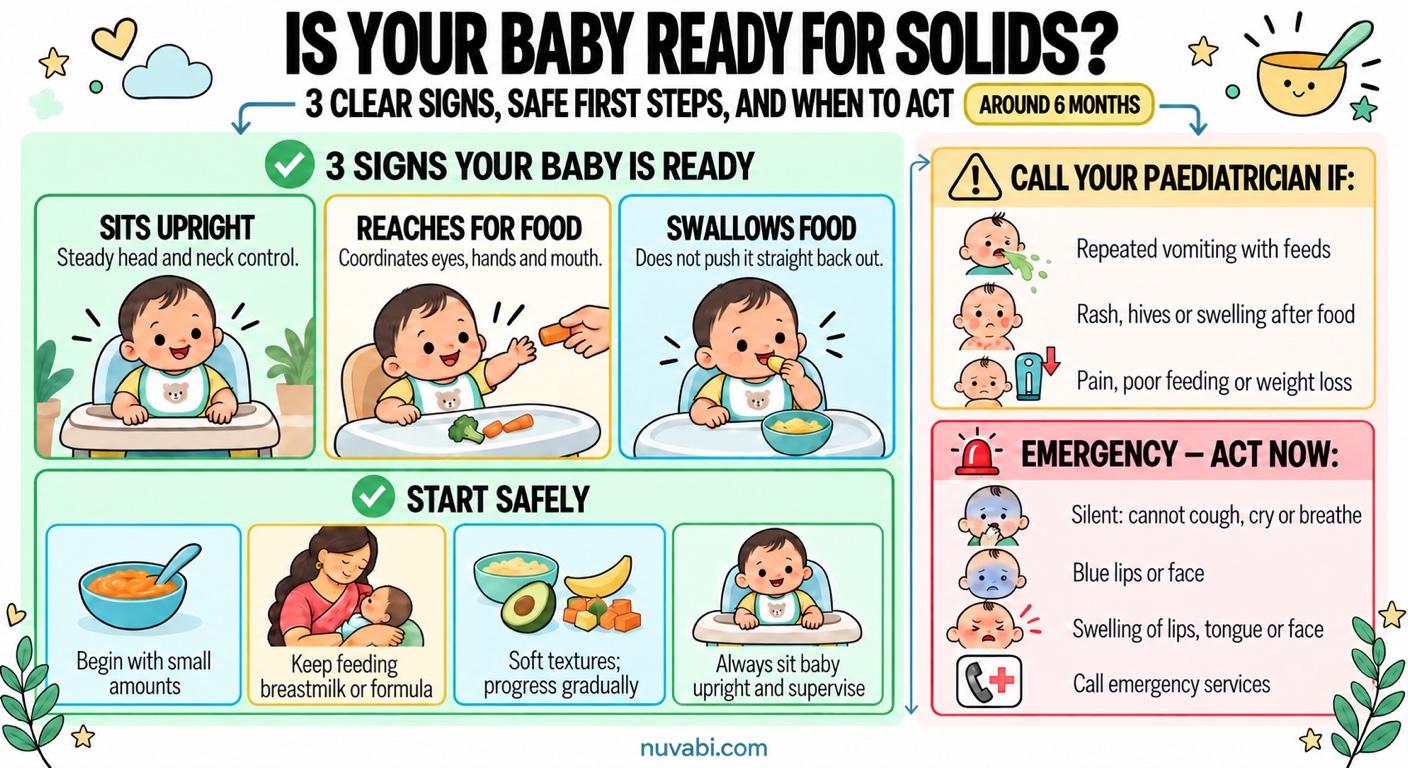
Save this for when your baby is ready to start solids.
✅ Normal — don't panic
- 🤢Gagging — Not choking. Gagging is loud and forceful, face goes red, resolves on its own. A normal protective reflex as they learn textures.
- 🙅Rejecting new foods 10–15 times — Research shows babies may need 15+ exposures before accepting a food. Rejection is not refusal.
- 💩Changed stools — Colour, consistency, and frequency all change when solids start. This is completely expected.
- 🍌Starting with bland foods — Dal water, rice kanji, mashed banana — perfect. You don't need a special baby food aisle.
- ⏰Tiny portions — At 6 months, two tablespoons per meal is a full serving. Their stomach is the size of their fist.
- 🧂No salt, sugar, or honey — Before 1 year, none of these. Kidneys aren't ready for salt; honey carries botulism risk.
- 🫙Home-cooked beats packaged — Indian food mashed and softened is genuinely more nutritious than packaged baby pouches.
When to act
⚠️ Pause and call your paediatrician if:
- Baby gags and vomits consistently with every feed — not occasional gagging
- Rash, hives, or swelling around the mouth within 1–2 hours of a new food — potential allergy
- Baby seems in pain after eating — arching back, persistent crying, possible reflux
- Baby is losing weight or refusing breastmilk/formula after starting solids
- Baby refuses solids entirely for 3–4 weeks after a genuine start
🚨 Go to emergency immediately if:
- Choking: baby goes silent (not gagging), face turns red then blue, cannot cry or cough — call emergency and begin infant choking first aid immediately
- Swelling of lips, tongue, or face after eating a new food — this is anaphylaxis, a medical emergency
- Baby loses consciousness after eating
Your Indian starter guide — month by month
Moong dal water, rice kanji, mashed banana, sweet potato puree, soft-cooked carrot. One new food every 3 days.
Thick dal, mashed khichdi, soft idli, curd (plain, no sugar), papaya. Add a tiny amount of ghee.
Mashed sabzi, soft-cooked egg yolk, curd rice. Textures can get lumpier — finger foods like soft banana pieces are fine.
Small roti pieces softened in dal, soft fish, full egg, soft paneer. Mild spices — jeera, haldi — are fine now.
Modified family meals — soft versions of what you eat. By 12 months, most babies eat family food with minimal changes.
Some days they'll eat everything. Some days they'll knock the bowl off the table. Both are fine. The research is clear that early experiences with food — including the mess, the play, the repeated offerings — shape a child's relationship with eating for years.
The mango mash on the ceiling is part of the process. 💙
You know your baby's patterns better than any guide does. If their eating seems genuinely off — if they're struggling or their reaction to a new food makes your stomach drop — reach out to your paediatrician. Trusting your gut is not overthinking. It's good parenting.
Track feeds and milestones with Nuvabi →Sources: Indian Academy of Pediatrics — Complementary Feeding Guidelines (2022) · AAP (American Academy of Pediatrics) — Starting Solid Foods recommendations · WHO — Complementary Feeding Guidelines