You had it figured out. You did. The swaddle, the white noise, the exact angle of the pram. Your baby was doing 5-hour stretches and you'd started to feel — cautiously, quietly — like yourself again. And then, overnight, it unravelled.
Nobody warned you about this. Or maybe they did and you filed it away as something that happened to other people's babies. Welcome to the 4-month sleep regression. It's real, it's temporary, and you're going to get through it.
First, a reality check
Here's the important thing: this isn't a regression at all. Your baby's sleep isn't going backwards — their brain is going forwards. At around 3.5 to 4.5 months, babies' sleep architecture permanently changes to match adult sleep, with distinct light and deep cycles.
If they fell asleep on the breast or in your arms, they'll wake between cycles looking for that same condition. That's the core of it. The disruption is usually worst in weeks 1–3 and most families see improvement by the 4–6 week mark.
| Age | Sleep architecture | Longest typical stretch |
|---|---|---|
| 0–3 months | Newborn cycles (less structured) | 3–5 hours |
| 4 months | Transitioning to adult-like cycles | Back to 1.5–2 hrs (temporarily) |
| 5–6 months | Adult-like cycles established | Can begin extending again |
What this looks like at home
This is the part that catches most families off guard. Everything seemed fine — and then one week it just wasn't.
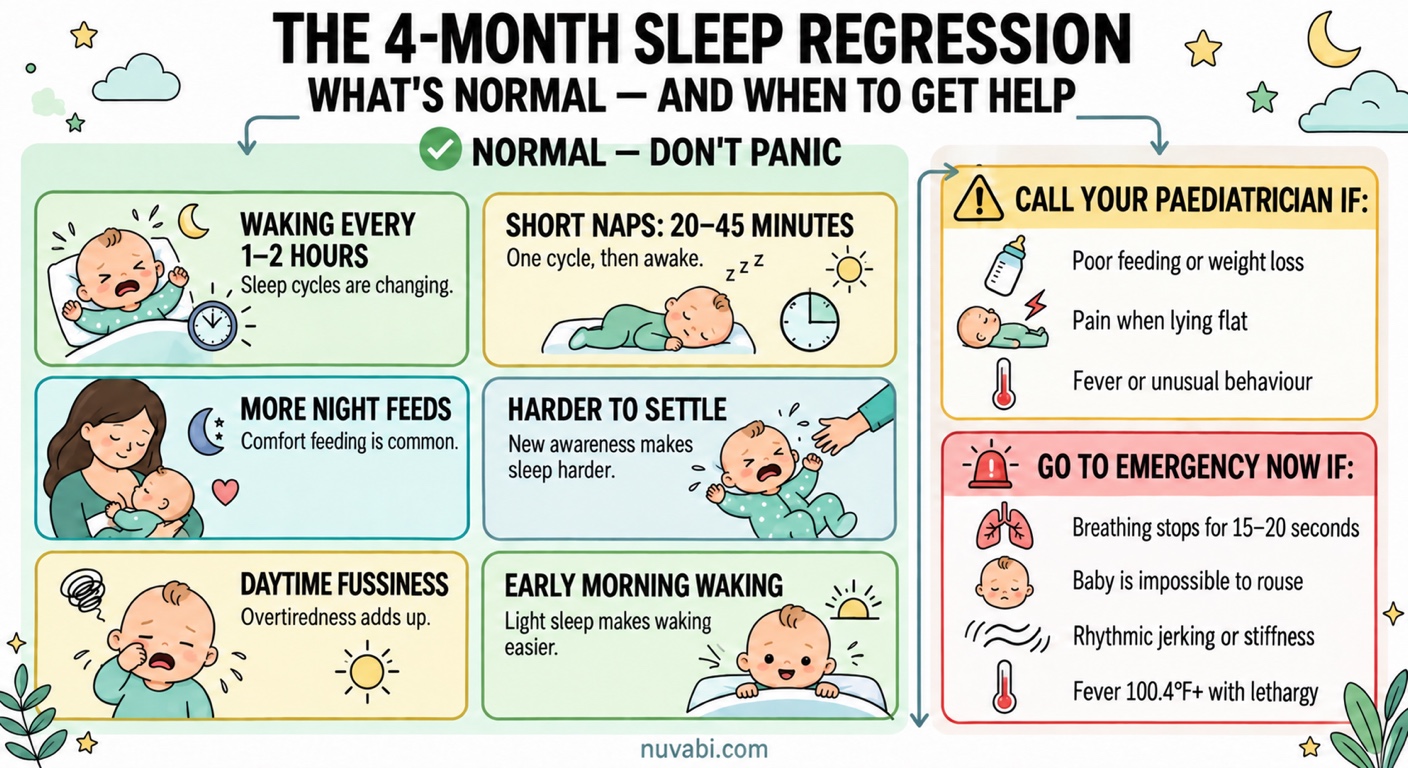
Save this. You'll refer back to it.
✅ Normal — don't panic
- 😴Waking every 1–2 hours at night — Sleep cycle transitions. Normal but exhausting. You're not doing anything wrong.
- ⏰Catnapping — naps now 20–45 minutes — One sleep cycle, then they wake looking for you. Completely expected at this age.
- 🍼Increased night feeding — Comfort feeding is common during this phase. Meeting the need is the right call.
- 😤Harder to settle than usual — Their sensory awareness has also spiked. Everything is more interesting. Settling takes longer.
- 😩Fussier during the day — Overtiredness has a cumulative effect. More settling help during the day is normal.
- 🌅Early morning waking — Light sleep in the early hours makes them easier to rouse. White noise helps bridge this.
When to get help
⚠️ Mention to your paediatrician if:
- Baby is losing weight or genuinely refusing feeds (not just feeding more at night)
- Baby seems to be in pain when lying flat — reflux often worsens at this age
- Sleep disruption is so severe that you or your partner are struggling to function safely
- Baby seems unwell alongside the sleep changes — fever, unusual behaviour, poor feeding
🚨 Go to emergency immediately if:
- Baby stops breathing during sleep for more than 15–20 seconds
- Baby is impossible to rouse after a long nap
- You notice rhythmic jerking or stiffness during sleep
- Fever of 38°C or above alongside lethargy
5 things that actually help
Counter-intuitively, an earlier bedtime (6:30–7:30pm) reduces overtiredness. Try pulling it 30 minutes earlier.
Not a timer — a constant sound machine running until morning. This bridges sleep cycles.
Put baby down when sleepy but still conscious. Frustrating at first, transformative over 5–7 days.
Bath, feed, song, sleep — same order every time. The predictability itself becomes a sleep cue.
Whatever you choose — patting, shushing, sitting nearby — give it 5–7 days before you assess.
Most families are through the worst of it within 4–6 weeks. A few weeks after that, many babies start sleeping in longer stretches than ever before — because their sleep is now better organised. The chaos has a destination.
You're not going backwards. You're going through. 💙
You know your baby's normal. If something about how they're sleeping feels wrong — not just hard, but genuinely off — trust that instinct. There's a difference between “this is exhausting” and “something is wrong with my baby.” If you feel the second one, call your paediatrician. Don't wait for morning.
Track sleep patterns with Nuvabi →Sources: AAP (American Academy of Pediatrics) — Sleep in Infancy and Childhood recommendations · Indian Academy of Pediatrics — Infant Sleep Guidelines and Developmental Milestones (2023)