Before the baby arrived, I thought feeding would be simple: choose the “best” option and get on with it. Then came the latch checks, the 3am pumping session, a bottle of formula on the kitchen counter, and the feeling that every choice needed defending.
Feeding is health care, but it is also daily life. The evidence supports breastfeeding, recognises commercial infant formula as an important alternative, and leaves far more room for mixed feeding than the internet usually does. Here is the useful version of that evidence — without pretending every family has the same body, baby, support, or choices.
First, the honest answer
WHO recommends exclusive breastfeeding for the first 6 months when possible, followed by complementary foods alongside continued breastfeeding. That recommendation reflects real population-level benefits. Breast milk contains antibodies and other living components that commercial formula cannot reproduce.
But a public-health recommendation is not a verdict on an individual parent. Commercial infant formula is designed to provide the energy and nutrients babies need for growth. For some families it is necessary; for others it is chosen; for many it is used alongside breast milk. The safest feeding plan is one that nourishes the baby and can be carried out consistently by a supported caregiver.
| What matters | Breast milk | Infant formula |
|---|---|---|
| Nutrition | Adapts over time; contains living immune factors | Nutritionally complete when correctly prepared |
| Intake | Estimated through feeding and growth signs | Volume can be measured directly |
| Access | Depends on supply, comfort, time, and support | Can be offered by another caregiver |
| Safety work | Latch, milk transfer, and storage matter | Exact preparation, cleaning, and storage matter |
Breast, bottle, or both — at a glance
The useful comparison is not which feeding method makes someone a better parent. It is what each method offers, what safety work it requires, and what your baby and family need.
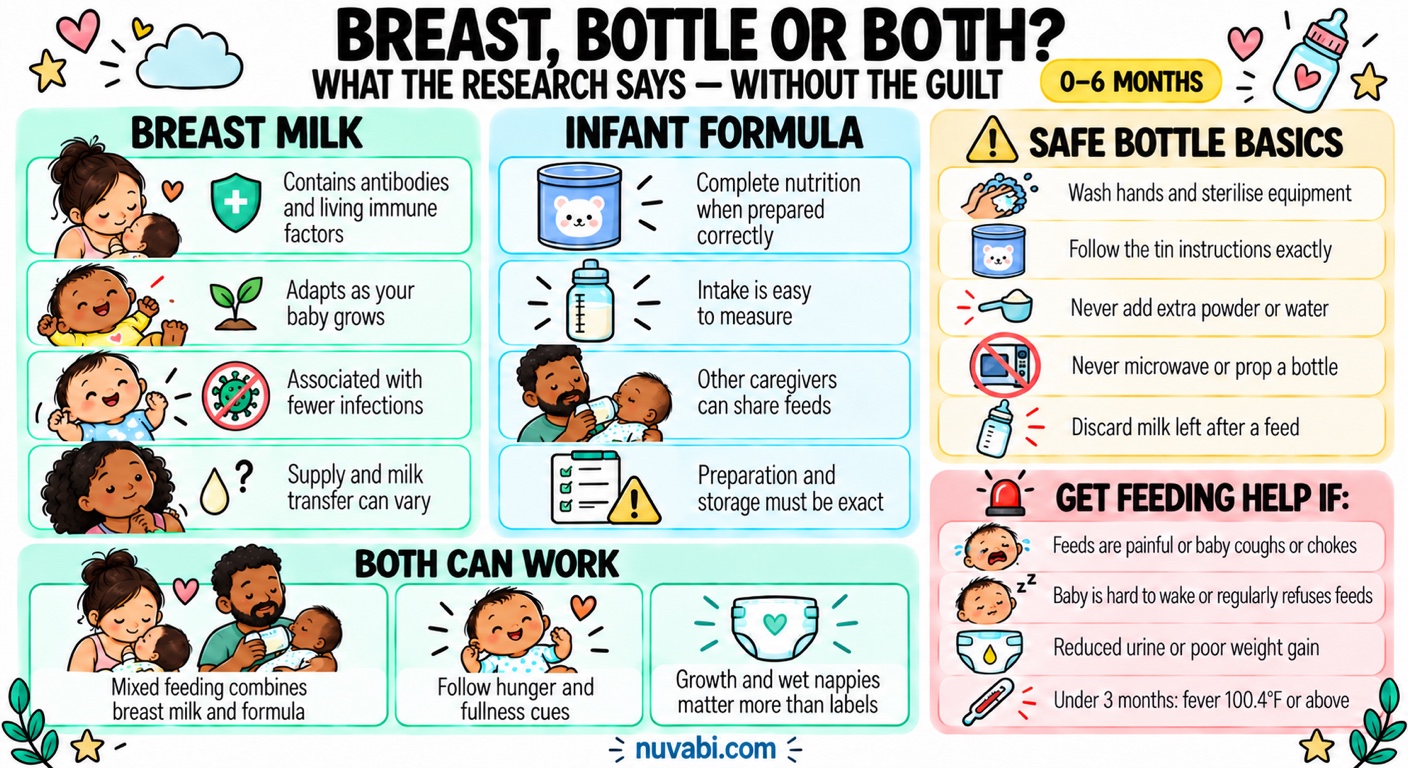
Save this for a calm feeding conversation without the guilt.
What breastfeeding genuinely offers
Breastfeeding is associated with lower rates of gastrointestinal infections, ear infections, and severe respiratory illness. It is also associated with a lower risk of sudden infant death syndrome. For the breastfeeding parent, longer lifetime duration is associated with lower risks of breast cancer, ovarian cancer, type 2 diabetes, and high blood pressure.
What the evidence does not mean
- It does not guarantee immunity. Breastfed babies still get infections and need routine vaccines.
- It does not make every feed easy. Pain, poor milk transfer, mastitis, and low supply deserve skilled support.
- It does not measure parenting. Feeding method is one part of a child's health environment, not a score for devotion.
What formula genuinely offers
Commercial infant formula is formulated to support infant growth and development. It provides a reliable option when breastfeeding is not possible, not desired, insufficient on its own, medically interrupted, or simply not the right plan for a family.
Bottle feeding can make intake visible and allow partners or other caregivers to share feeds. Those practical benefits matter. They can affect sleep, recovery, work, mental health, and whether a feeding plan is sustainable.
Formula safety is part of the nutrition
- Use commercial formula intended for your baby's age; never use homemade formula.
- Wash hands and clean and sterilise bottles, teats, and preparation equipment.
- Use safe water and follow the package instructions exactly. Never add extra powder or water.
- Powdered formula is not sterile. Follow local guidance and your paediatrician's advice for preparation.
- Never warm a bottle in a microwave, prop a bottle, or save milk left after a feed for later.
Mixed feeding is a real feeding method
Mixed feeding means combining breastfeeding or expressed milk with formula. It can be temporary while supply builds, part of returning to work, a way to share care, or the plan from the beginning. It does not have to be treated as a failed version of exclusive breastfeeding.
Milk production responds to milk removal, so replacing breastfeeds can reduce supply. If maintaining supply matters to you, a lactation professional can help plan when to breastfeed, express, or offer a bottle. If exclusive breastfeeding is not your goal, you do not need to pump simply to satisfy somebody else's definition of success.
What matters with either breast or bottle
Offer a feed when baby roots, brings hands to mouth, or becomes restless. Crying is a late hunger cue.
Let baby set the pace. Do not pressure them to finish a breast or bottle once they show fullness cues.
Weight trend, wet nappies, alertness, and effective swallowing matter more than one short or long feed.
Persistent pain, poor latch, frequent coughing, or slow weight gain deserves assessment — not more self-blame.
When to get feeding help
Call your paediatrician or feeding specialist if:
- Feeds are consistently painful, exhausting, or accompanied by clicking, coughing, or choking
- Baby is difficult to wake for feeds, regularly refuses feeds, or takes much less than usual
- Wet nappies decrease, urine becomes dark, or baby's mouth looks dry
- Baby is not regaining birth weight or is not following their expected growth pattern
- You feel persistently anxious, low, trapped, or unable to continue the current feeding plan
Seek urgent medical care if:
- Baby has trouble breathing, turns blue, becomes limp, or is difficult to wake
- Baby under 3 months has a temperature of 100.4°F or above
- Vomiting is green, bloody, or forceful and repeated
- There are clear signs of dehydration or baby appears seriously unwell
Breastfeeding has real benefits. Formula is an important, nutritionally complete alternative. Mixed feeding can combine the two. Those statements can all be true at once.
The goal is not a perfect label. It is a nourished baby and a feeding plan your family can safely sustain.
If feeding is hurting, frightening, or consuming every part of your day, ask for help early. A good feeding conversation starts with your goals and your baby's health — not with guilt.
Track every kind of feed with Nuvabi →Sources: World Health Organization — Breastfeeding and Infant and Young Child Feeding guidance · CDC — Breastfeeding and Infant Formula guidance · NHS — Mixed Feeding guidance · American Academy of Pediatrics — Infant Feeding guidance