It was 11:47pm. My daughter had been fed, changed, burped, rocked, and sung to. She'd rejected the pacifier three times. My husband and I stood in the hallway doing that helpless thing where you just stare at each other — not because we were fighting, but because neither of us had any ideas left.
If you've been there, you already know that the hardest part of early parenthood isn't the sleep deprivation. It's the not-knowing. And the crying is the loudest not-knowing of all. Here's everything I wish I'd had in those first months.
First, a reality check
Crying is your baby's only language right now. They can't wave you over or tap your shoulder — sound is their entire communication system. The crying itself isn't the problem. It's a signal. And most of the time, it's one of five very ordinary things.
The “Period of PURPLE Crying” — a term used by paediatricians — describes this arc: crying peaks around 6 weeks and then, slowly, it eases. It's not permanent, even when it feels permanent at 2am.
| Age | Average crying / day | Peak period |
|---|---|---|
| 0–2 weeks | 1–2 hours | Evening cluster feeds |
| 2–6 weeks | 2–3 hours (peak) | 6pm–midnight |
| 6–12 weeks | Gradually reducing | Still often evenings |
The 5 common cries — and what they mean
Once you know what you're listening for, you start to hear differences you didn't notice before. Hunger cries build. Tired cries whimper. Gas cries are sharp and sudden. It takes a few weeks — but you will learn your baby's language.
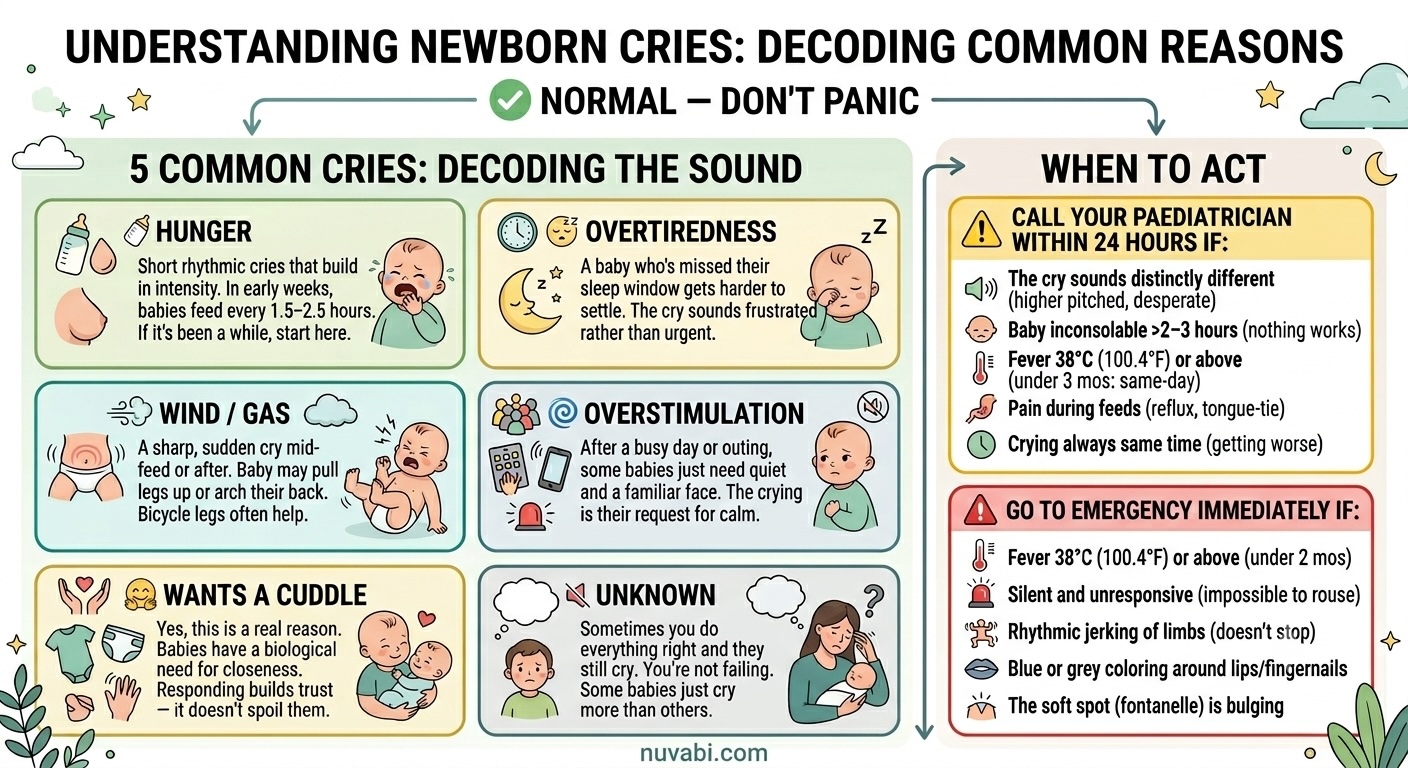
Save this. You'll come back to it.
✅ Normal — don't panic
- 🍼Hunger — Short rhythmic cries that build in intensity. In early weeks, babies feed every 1.5–2.5 hours. If it's been a while, start here.
- 😴Overtiredness — A baby who's missed their sleep window gets harder and harder to settle. The cry sounds frustrated rather than urgent.
- 💨Wind / gas — A sharp, sudden cry mid-feed or after. Baby may pull legs up or arch their back. Bicycle legs often help.
- 🌀Overstimulation — After a busy day or outing, some babies just need quiet and a familiar face. The crying is their request for calm.
- 🤗Wants a cuddle — Yes, this is a real reason. Babies have a biological need for closeness. Responding builds trust — it doesn't spoil them.
- 😣Discomfort — Something's rubbing, something's tight. Check the nappy, the clothes, and the fingers and toes for a hair tourniquet.
- 🔇Unknown — Sometimes you do everything right and they still cry. You're not failing. Some babies just cry more than others.
When to act
⚠️ Call your paediatrician within 24 hours if:
- The cry sounds distinctly different — higher pitched, more desperate, unlike their usual cries
- Baby is inconsolable for more than 2–3 hours and nothing works at all
- Fever of 38°C or above (under 3 months: same-day call, no exceptions)
- Baby seems to be in pain every time they feed — could be reflux or tongue-tie
- Crying always happens at the same time daily and is getting worse — could be colic
🚨 Go to emergency immediately if:
- Fever of 38°C or above in a baby under 2 months — paediatric emergency
- Baby goes silent and unresponsive, or is impossible to rouse
- Rhythmic jerking of the limbs that doesn't stop when you hold the limb still
- Blue or grey colouring around the lips or fingernails
- The soft spot (fontanelle) on top of the head is bulging
The calm-down grid: try these in order
Hunger cues are easy to miss. A comfort feed never hurts.
Regulates baby's temperature, heart rate, and stress hormones. Often the fastest reset.
Mimics the constant sound of the womb. A fan, running tap, or app all work.
Rocking, bouncing, carrier walk. Rhythmic movement is deeply calming for young babies.
Take them outside. Fresh air and new sensory input can break the crying loop surprisingly fast.
Somewhere between 8 and 12 weeks, something shifts. You start to know the difference between the “I'm tired” cry and the “I'm in pain” cry. You develop instincts you didn't know you had. It doesn't feel like it right now — but you will get there.
And that moment when you get it right — when you know exactly what they need — feels like magic. 💙
Your instincts about your own baby are real and worth listening to. If something about the crying feels wrong to you — not just hard, but genuinely off — trust that feeling and call your paediatrician. You don't need a reason beyond “it feels different.” That's enough.
Track feeds and patterns with Nuvabi →Sources: AAP (American Academy of Pediatrics) — Period of PURPLE Crying guidelines · Indian Academy of Pediatrics — Infant Care and Colic Management Recommendations (2023)