It starts around the same time every evening. 6pm, maybe 7. The crying builds like it has its own momentum — different from hunger, different from tiredness. You've fed them. You've changed them. You've walked, bounced, sung, shushed, and cried a little yourself. And then, usually somewhere between 2 and 3 hours later, it just stops.
If you're living through this every evening, you might be dealing with colic. And if you are — I need you to hear this: it is not your fault, it will not last forever, and you are not alone.
First, a reality check
Colic is defined by the “Rule of Three”: crying for more than 3 hours a day, more than 3 days a week, for more than 3 weeks, in an otherwise healthy, well-fed baby. It affects roughly 1 in 5 babies regardless of birth type, feeding method, or parenting style. Indian babies get it at the same rate as babies anywhere else.
Nobody fully understands what causes it. The peak at 6 weeks is real and brutal. But about 90% of colicky babies are significantly better by 3 months. The light at the end of the tunnel is real too.
| Age | Colic pattern | What to expect |
|---|---|---|
| 2–3 weeks | Begins, often mistaken for hunger | Evening crying pattern starts to emerge |
| 4–6 weeks | Peak intensity | Most families find this the hardest period |
| 3 months | Significant improvement | Crying reduces, pattern becomes less predictable |
Is it colic? Here's what it actually looks like
The most important marker: a colicky baby is completely fine between episodes. Alert, gaining weight, feeding normally. That distinguishes colic from something that needs immediate investigation.
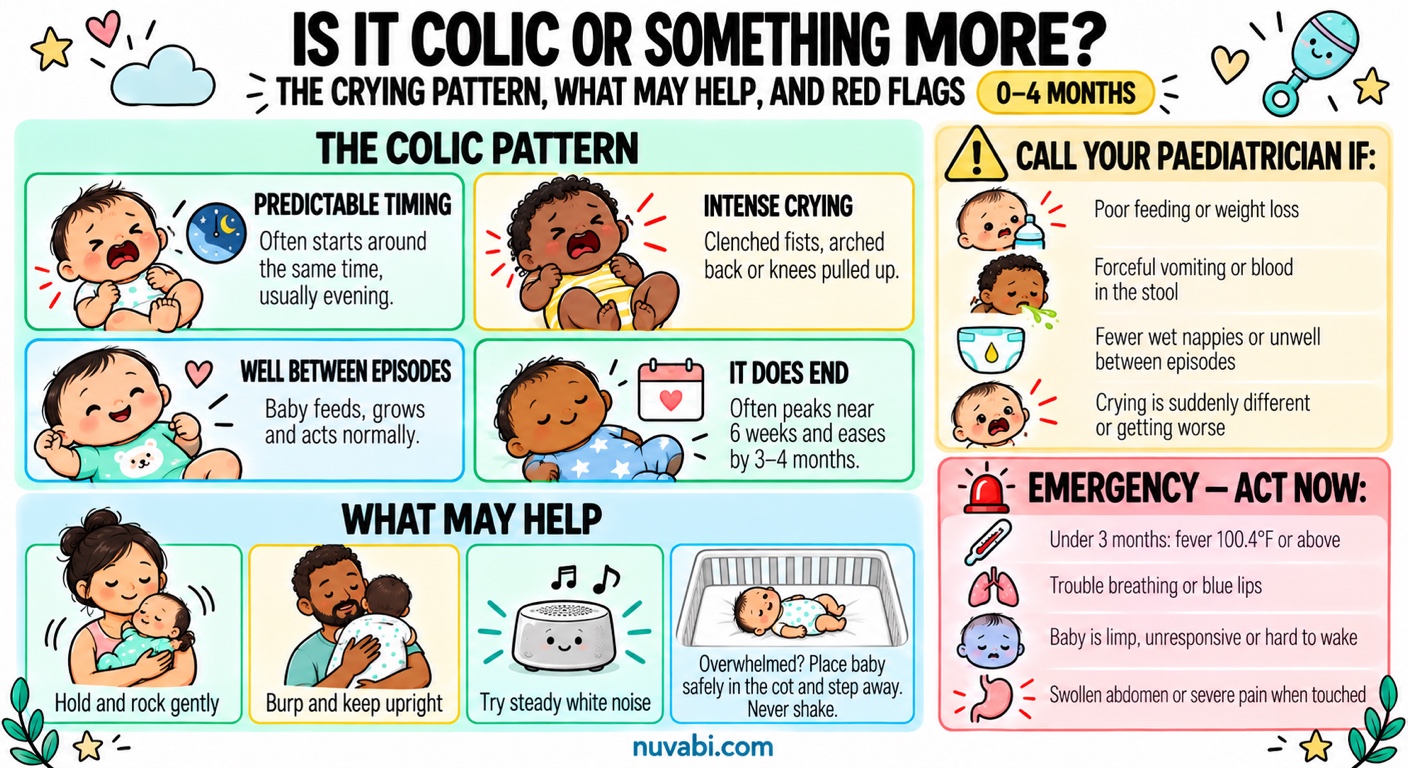
Save this for the next difficult crying spell.
✅ Normal colic signs — you're not doing anything wrong
- 😭Predictable evening crying — Often called the 'witching hour' — usually 2–3 hours, starting and stopping around the same time daily.
- 🤜Clenched fists, arched back, pulled-up legs — Classic colic posture. Baby looks like they're in pain. They may be experiencing real discomfort.
- 🔊High-pitched, intense cry — Different from hunger crying. More desperate. Harder to console. Normal for colic.
- 🔄Passing gas frequently — Not necessarily the cause — swallowing extra air during crying creates more gas. Chicken-and-egg situation.
- 🍼Doesn't stop with feeding — Overfeeding can make gas worse. Smaller, more frequent feeds often help more.
- ☀️Fine during the rest of the day — This is the key. A colicky baby is alert and well between episodes.
When to get help
⚠️ Call your paediatrician within 24–48 hours if:
- Baby is not gaining weight — sometimes what looks like colic is an undiagnosed feeding issue
- Crying accompanied by blood in the stool or forceful vomiting — possible allergy or obstruction
- Crying doesn't follow any pattern and is progressively getting worse, not staying consistent
- Baby seems genuinely unwell between episodes — lethargic, not feeding, fewer wet nappies
- You or your partner are at a breaking point — sleep deprivation plus relentless crying is genuinely traumatic. Ask for help. This is not weakness.
🚨 Go to emergency immediately if:
- Cry accompanied by fever of 38°C or above — rules out infection first
- Baby stops breathing or turns blue during a crying episode
- Baby goes completely limp or unresponsive after prolonged crying
- Swelling of the abdomen or baby screams when you gently press the belly
What the evidence actually says helps
Moderate evidence, especially for breastfed babies. Ask your paediatrician for a brand. Not all probiotics are equal.
Good evidence. Mimics womb environment, often calms the nervous system during an episode.
Good evidence. Rhythmic movement — carrier, pram, gentle bouncing — is deeply calming for young babies.
Helps move trapped gas. Clockwise circles, gently. Can shorten episode duration.
Good evidence. Regulates baby's nervous system, often shortens episode duration.
Colic is one of those things that tests you in ways you didn't expect parenthood to test you. Not because you're not good enough — but because it is genuinely, objectively hard. Millions of parents are doing exactly the same thing tonight. And it does end.
You are not doing anything wrong. You are doing everything right. 💙
Your instincts about your own baby are real and worth listening to. If something about the crying feels like more than colic — if they seem genuinely unwell, if something is different — follow that instinct to the phone. A good paediatrician would always rather reassure you than miss something.
Track crying patterns with Nuvabi →Sources:Indian Academy of Pediatrics — Infantile Colic: Management Guidelines (2022) · AAP (American Academy of Pediatrics) — Colic Relief Tips for Parents · Sung V et al., “Lactobacillus reuteri to treat infant colic” — BMJ (2018)